Since I am part of a living learning community on campus I must participate in a "hall beautification" project for our floor of the Suites here on campus. I am really excited about this project because it uses my major in a very unique way. What we are doing is incorporating the campus read this year, "The Boy that Harnesses the Wind" and putting that idea into the Boise metropolitan area. I think that this will be really fun because we get to take lots of pictures of Boise and then mount them on canvas and paint our interpretation of a windmill on them. This will help bring the message of William Kamkwamba's book reach Boise. I think that this project will be really cool because it is really an interesting idea that I think will make an impact on the community. I think that the project is sophisticated and visually appealing to the viewer, or at least the idea seems to be to me anyways. I am very excited to be working on this with 3 other girls in the community and I hope that it will turn out really cool!
I have a sort of connection with this piece, more so than I do with other pieces that we do in the community because this one really involves what I love the most, photography. I think that I can get some really spectacular pictures of downtown or of the parks or even at the zoo that can really show how much Boise is trying to "go green". I am really in love with the idea of making the pictures black and white and then painting the windmills on top of the print in bright colors so that it looks as if the windmills are something exciting and bright in the community of Boise. I think that this encompasses what the University wants us to get out of the book which I think is this idea of ingenuity and doing something for the good of our community. I can't wait to start on this and really hope that it will turn out just as we had planned, if not better.
Friday, October 15, 2010

Critique #2
This week we had critique and I think it went really well. There was a lot of cool projects that were displayed including a purse with things like cigarettes and coins made out of wood pencils and wax forms. There was also a pair of shoes made out of tin cans which I thought were really neat. The quality could have been better, I think, but everyone else seemed to really like them since they were so cool! I think that my favorite piece was either the one made out of coffee filters or the one made out of tampons.
 The one made out of coffee filters was really cool because they looked so intricate, yet they were very simple in design. The artist took a concept that was very inline with what Tara Donovan does and made it into something elegant and gorgeous! In the end there were three spherical forms that she then suspended from the ceiling. The piece were great because they were so simple, yet they grabbed your attention because of the way that they made you move around them. They were an obstruction in the room, but that was part of the piece. The forms were visually heavy, but when the viewer moved around them they would seem to bounce due to the way that the artist had hung them. I think that this piece was really cool because of the way that the folded coffee filters made interesting lines throughout the spheres. They made sense in the space and you could easily fill a room with them if you wanted to imitate Tara Donovan's truest style.
My other favorite was a pillow, made of tampons. The pillow was very elegant in form, and if you looked at it from far away you couldn't really tell what it was made of. It had a red rose embroidered on it, which I thought was ironic because of what tampons are usually used for. It was an interesting choice of color. However, the way that the pillow was displayed did not help solidify its meaning at all. It was just laid on a table, so it kind of looked like a large tampon, just sitting on the table, instead of an elegant pillow that it could be. However, the piece was very nice and the craftsmanship was extremely well done. All in all it was a really good piece.
As for my project, the hanging cups, the critique went well. It was interesting to hear what everyone had to say about it. Nothing bad, nothing really good either. Some said that it would be nice to have a background to separate the piece from the wall, which I completely forgot. I should probably remember that next time. Another said that it was very crazy, which reminded him of a party. One other student said that there was no place for the eye to rest except in the middle, which I agree with, since that is the way that I intended it.
In the end the final piece did not look anything like what I thought it would, but I think I actually liked it better. It was a very good critique I think and I hope I improved on my artist statement just a tad so I won't do as bad this time.
Tuesday, October 12, 2010
Rebecca Horn

One of her most famous works is called the body-extensions. In this installment she plays with the body and its reaction to the space that it is in. This has given into her works now that deal with structures that she has created that take on their own life and how they react in the space that she puts them in. She is also fond of mirrors, light, and music since they seem to help the artwork cut through the space that it is put in.
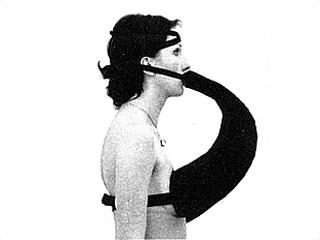
Her work is very interesting to a person who has been following her for a long time as well as a new viewer. However, the viewer that has been following her for the longer time has a sort of advantage in viewing her work since it tends to build upon itself. When she reveals a new work, it is apparent that she has used her previous work and has built off of or modified it in some way. The materials that she may have used in a previous work will reappear in future works but in a completely different way however.
She is seen as a visionary in the art world because she continues to tear down the walls built between space and time. She continues to break the boundaries opening up new worlds to be explored in her art, and give the viewer only a sense of what she feels while making her pieces.

I think that she is a true inspiration to anyone in this field and she is a beautiful artist. She has a deepness in her work that is hard to find in artists now a days. She thinks her artwork through and really likes to analyze the way that things react in their environment. I like the though that she puts into her pieces because it really shows in the final works. She puts so much detail into every piece that it makes the viewer fall in love with the way she fashions her art.
Saturday, October 9, 2010
Cornelia Parker
Cornelia Parker was born in Cheshire, UK in 1956. She is an English sculptor and installation artist that specializes in deconstructionism. She studied at Gloucestershire College of Art and Design in 1974 then moving onto Wolverhampton Polytechnic in 1975. She received her MFA from Reading University in 1982, since then she has received many honorary degrees from many of the colleges that she attended.
 Her most notable works include a blown up garden shed and 30 smashed pieces of silver. Her transformations of everyday objects play with the general meaning of things like decorum and utility. She enhances the importance of certain objects by making people question whether or not this object is particularly important or not. Also, Parker likes to make connections with historical figures and her artwork today. She enjoys collecting relics that are famously used and making them into pieces of art. Some say that this would be defacing of the themselves, however, I think that what she does makes the relics that much more charitable and humble in their meaning.
The artist loves to resurrect things that have been shut out of everyday use in today's modern society. She likes to look at the possibilities of the materials rather then look at how they had been used in the past, and how the had failed or succeeded at that task. She transforms these avoided objects by burning, stretching, cutting, or making the object explode. Then she uses the materials that she manipulates to make these beautiful, and definitely unique pieces of artwork.
 One of her projects that was worldly recognized was one called Pornographic Drawings. This project involved her melting down tapes of old porno videos and using the ink to draw with. She got the tapes from H.M. customs and Excise. They were confiscated in the late 1960s for being to risque for the public to view. Now out of date H.M. basically gave her the tapes for free. As you can see, from the image on the right, the drawings are mimics of each other if folded in half. She drew them this way to symbolize unity and similarity in the society that we live in, however, when we get underneath the surface we all have things that we want to hide, however, it makes us who we are.
Parker is also obsessed with the way cartoon deaths mimic those in real life. She like to think about the uncontrollable and use that vision to make something that is quiet and contemplative. She like to make the human mind think through her works as well as comment on the social acceptance of violence, globalization, consumerism, and mass- medias affect in our lives. She does this be taking the most ordinary objects and making them into something compelling and extraordinary for the viewer.
 I think that the most compelling thing about Parkers work is the fact that she takes something that we all use in life and basically destroys it for the sake of art, yet she does it in a way that make the viewer question everyday reality and the meaning of things that are useful to them. I like the way that she makes the art huge, and lager than life, however, to get the meaning of the piece it is intricated into every piece of material that she uses. She is a truly amazing artist and a visionary. She is not afraid to make a statement and ruffle some feathers of the viewer so that she can make them thing of things that are truly important to them.

The artist loves to resurrect things that have been shut out of everyday use in today's modern society. She likes to look at the possibilities of the materials rather then look at how they had been used in the past, and how the had failed or succeeded at that task. She transforms these avoided objects by burning, stretching, cutting, or making the object explode. Then she uses the materials that she manipulates to make these beautiful, and definitely unique pieces of artwork.

Parker is also obsessed with the way cartoon deaths mimic those in real life. She like to think about the uncontrollable and use that vision to make something that is quiet and contemplative. She like to make the human mind think through her works as well as comment on the social acceptance of violence, globalization, consumerism, and mass- medias affect in our lives. She does this be taking the most ordinary objects and making them into something compelling and extraordinary for the viewer.

Friday, October 8, 2010
Jason Rogenes
American Artist Jason Rogenes was born in 1971 in Milwaukee, Wisconsin. After acquiring a taste for art as a child and through his teen aged years he decided to attend the University of California San Diego for a Bachelor's Degree and graduated in 1993. In 1995 he graduated from the Skowhegan School of Painting and Sculpture in Maine. And finally in 1995 he graduated with a M.F.A. from the University of California Santa Barbara.
 He specializes in producing art in mostly LA and NYC that deals with mainly post consumerism products such as Styrofoam, cardboard, and tape. He combines theses materials and makes them into a beautiful sculpture like piece, without doing hardly any work. He uses Styrofoam from TV packages, cardboard boxes, and other materials like this to make high-tech looking pieces. He explores the idea of what consumers waste in the process of getting what they really want. Which reflects on how people in real life will do anything to get what they want at any cost.
The artist takes a simpler approach to making his pieces. He really wants to explore the materials that he is working with, so therefore, so he learns how to make them. He then looks at the material as a solid and undefined object, so it can be anything that he wants it to be. He then works with the material to see what its limits are and how he can carve and manipulate the forms to become something beautiful and unique.
Rogenes also is a master at taking advantage of the blurring lines of architecture and sculpture than has been happening for many years. He take advantage of this by making his pieces large and dominant in the space that they reside. However, they command a sense of respect with their elegant beauty and prestige. He is excellent at finding a balance between the materials so that they compliment each other while still having an importance of individualism.
 The artist also does a remarkable job of having the pieces resemble that of a space station of a transportation unit used in space travel. It is ever present that the artist plays into the viewers sense of fantasy and bringing the impossible into the possible through Styrofoam. He well defines what is and is not his style by commanding that he be the greatest Styrofoam/packing material artist that their ever was, I agree with this. He has a way about him that makes you think that he can make virtually anything that you want out of any packing material.
He does not make his artwork figure to necessarily mean anything, rather he uses his materials to comment on the social issues that are going on in our world today. He discovered his material while working in a small mall in the LA area. He noticed how many people were throwing away the material and wondered how it could be used. He took some and, with his art background, started to make sculpture out of them. They turned into theses massive, intricate figures that it turnes out, people want to buy or display in their gallery.
 The artist is very humble about the fame that his artwork has encountered recently. He thinks that he is blessed, yes, but he does not throw it onto you like you should know who he is. He finds the fact that he comes upon the materials by chance as a gift, like he was supposed to use this material for art, and to make a statement to the public about their unnecessary waste.
I think that his artwork is truly amazing! It is stunning and massive so that is commends your attention. He makes the art in a way that makes theses useless objects useful and even beautiful in the process. I think that they are so very gorgeous and really help emphasize how much out community wastes as a society.

The artist takes a simpler approach to making his pieces. He really wants to explore the materials that he is working with, so therefore, so he learns how to make them. He then looks at the material as a solid and undefined object, so it can be anything that he wants it to be. He then works with the material to see what its limits are and how he can carve and manipulate the forms to become something beautiful and unique.
Rogenes also is a master at taking advantage of the blurring lines of architecture and sculpture than has been happening for many years. He take advantage of this by making his pieces large and dominant in the space that they reside. However, they command a sense of respect with their elegant beauty and prestige. He is excellent at finding a balance between the materials so that they compliment each other while still having an importance of individualism.

He does not make his artwork figure to necessarily mean anything, rather he uses his materials to comment on the social issues that are going on in our world today. He discovered his material while working in a small mall in the LA area. He noticed how many people were throwing away the material and wondered how it could be used. He took some and, with his art background, started to make sculpture out of them. They turned into theses massive, intricate figures that it turnes out, people want to buy or display in their gallery.
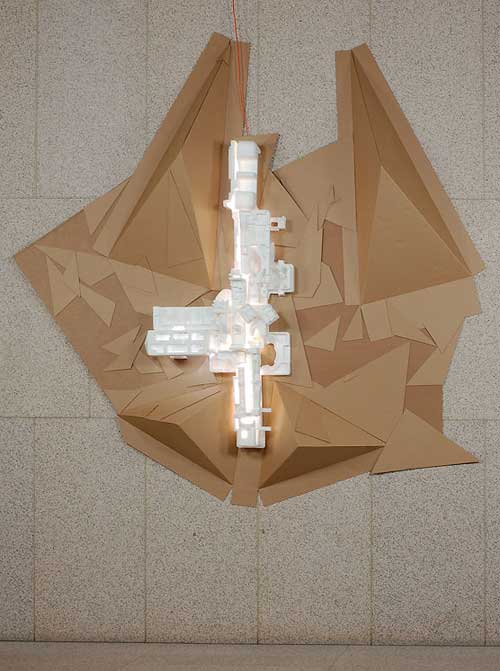
I think that his artwork is truly amazing! It is stunning and massive so that is commends your attention. He makes the art in a way that makes theses useless objects useful and even beautiful in the process. I think that they are so very gorgeous and really help emphasize how much out community wastes as a society.
The Dead Mans Cell Phone
I went and saw the Boise State Theatre production of The Dead Mans Cell Phone by Sarah Ruhl, directed by BSU's own Valerie Baugh-Schlossberg. The story starts out that a woman sitting in a cafe hears a mans phone ring, and when he neglects to answer it several times, she gets up to go answer it herself, only to find the man dead. She continues to answer the phone for several days after this dead mans funeral. She becomes romantically involved with his brother, tries to console the mourning wife and mother, and also tries to make his shoty business decisions right again. However, in her relationship with the dead mans brother, Dwane, he soon becomes jealous of the attention the main character, Gene, is giving to his dead, and frankly not well remembered, brother. Gene then dies due to a series of unfortunate events and finds herself alone with Gordon, the dead man. She questions
 why she is there with him of all people, seeing as how she had only "met" the man a few short days before hand. He tells her that when you die, you go to the person or place that you loved most in your worldly life, she loved him the most. However, Gene refuses to give up, and eventually finds her way back to earth and her way back to Dwane, and they fall madly in love, do to the death of his brother.
I think that in a sense this dramatic was very artistic. I think that Ruhl has written an excellent piece. Although weird in some places, the experience of seeing this play will in a way draw the viewer into the idea of how technology separates society into their own world, when it is really meant to bring us all together. I think that technology is good, when you don't let it destroy you. It was made so that you could be accessible at all times, so you can be reached if needed; however, some use it to tear people apart and build a wall in between themselves and the rest of society.This play addresses that well. It has made me think about how my life might go on after I have dies because of these things that we are so obsessed with having. We see the necessity of having the ability to be reached at all time through our phone, but neglect the fact that there is people outside of our phones, and they would like to be talked to rather than just e-mailed of texted.
As for our theatrical reproduction of this play, I think it went really well for the theatre space that we had. The audience was small and intimate and felt as though they were looking onto someones private life, as if the person that had died was watching their life pass by after they were gone. It has a very delicate complexity about it due to the fact that sometimes the dead man, Gordon, is watching what happens after his death, he even talks to you about what he thinks is good and bad about what happened the day he dies.
I think that the play write is trying to inform her viewers about how important actual society is rather than the technological side of our lives today. She is making a warning perhaps to not get so wrapped up in technology that when we die, people are more interested in the things we leave behind then the actual fact that they have lost someone near to their heart, or should have been near anyways.
Tuesday, October 5, 2010
Project Number 2 #4
I have actually started working on my project. Which is good. I have started cutting the cups and really getting a picture of what my project will look like in the end. I think it will be super sweet! I think that the simplicity of the material and the complexity of the design will really be good for the viewer because then they will have a change to question what the material is, something that is used everyday, but they will be given the chance to admire the design elements of the piece.
So here are my drawing for this project.


I know that some of them are lopsided......but yea.
The main gist of the project is such.
1. take a regular plastic cup and cut the bottom and the ring off of the top of the cup.
2. cut the cup in a way that it will spiral around just like a spiral of a notebook.
3. do this a bunch of times until you get around 200 of them.
4. suspend them from the ceiling at eye level so the viewer feels surrounded by the cups.
5. paint some to give the eye a place to rest and scatter those in with the white cups.
6. enjoy.
I think that this is going to be a super cool project once I get it up and running. Its gonna take me a while to hang, but I think the end effect will be really cool. I want my viewer to be able to play with the cups and not be afraid to touch them, because I like art that you can experience. And I think that is just what this is. :)
Subscribe to:
Posts (Atom)